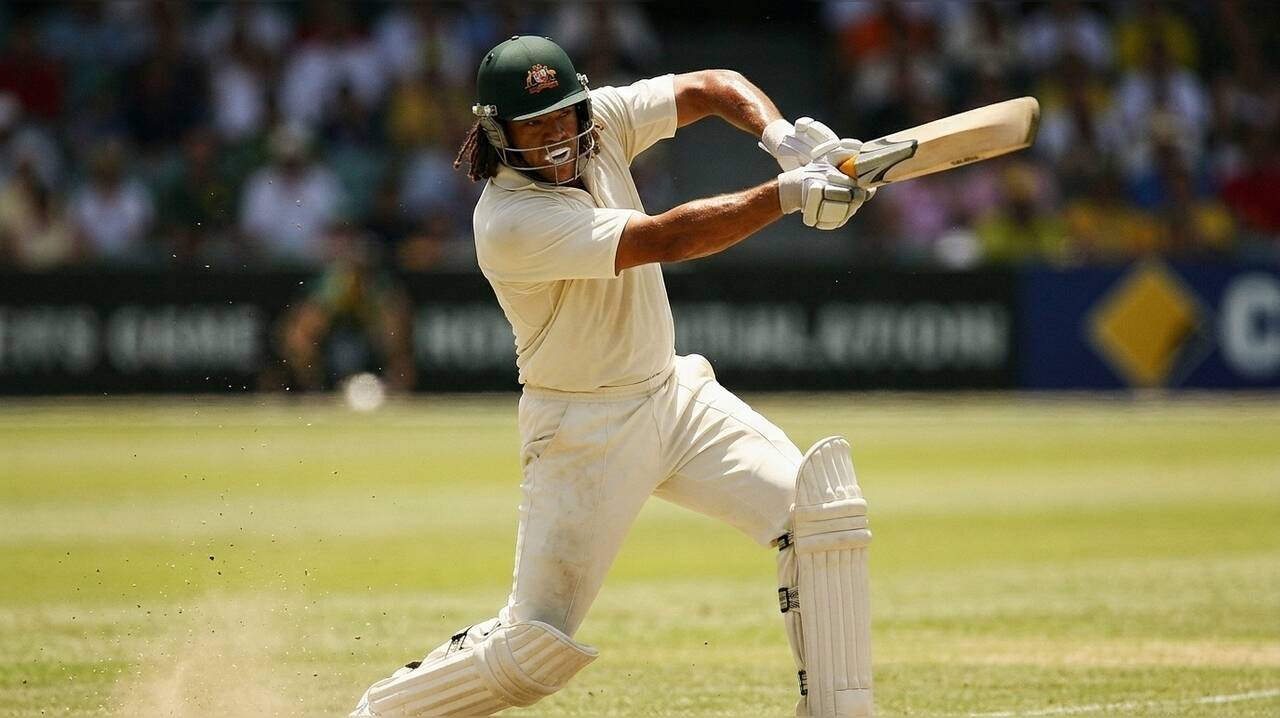
In the annals of
The incident occurred during Australia's innings, with the hosts sitting at 124 for four in the 46th over. Facing New Zealand fast bowler
A Masterclass in Opportunistic Scoring
The expansive nature of the Gabba outfield allowed Symonds and his batting partner, Michael Clarke, to complete three runs before the ball was retrieved. Sensing an opportunity to punish the fielding side, the pair pushed for a fourth run as the ball was thrown back toward the stumps. New Zealand wicketkeeper Brendon McCullum collected the return and attempted to run out the batter, but with Symonds already safely in his ground and no fielder positioned behind the stumps to back up the throw, the ball raced away to the boundary.
Umpire Rudi Koertzen signaled the outcome by raising eight fingers, confirming that four runs had been completed and four overthrows had been added to the total. It was a rare statistical anomaly, occurring only four times in the history of Test cricket at that point. The previous instances included Patsy Hendren in 1928-29, John Wright in 1980-81, and Brian Lara in 2004-05, though Lara's total was bolstered by five penalty runs awarded after a throw struck a helmet left on the field.
The Rarity of the Eight-Run Feat
While eight runs from a single delivery is a rarity that defies conventional scoring, the history of first-class cricket reveals even more extreme examples. Records show 14 instances where batters managed to run nine runs from a single ball, though all of these occurred before 1949. One such instance in 1900, involving Samuel Wood, took place during an experimental period where boundaries were replaced by high nets, forcing players to run for every single point.
Symonds' effort at the Gabba remains a standout moment of modern Test cricket, serving as a reminder of how quickly a routine delivery can descend into chaos. Despite the excitement of the eight-run haul, the drama was short-lived for the batter, who was dismissed by O'Brien just two balls later. Nevertheless, the sequence remains a fascinating footnote in the history of the game, highlighting the unpredictable nature of cricket at the highest level.