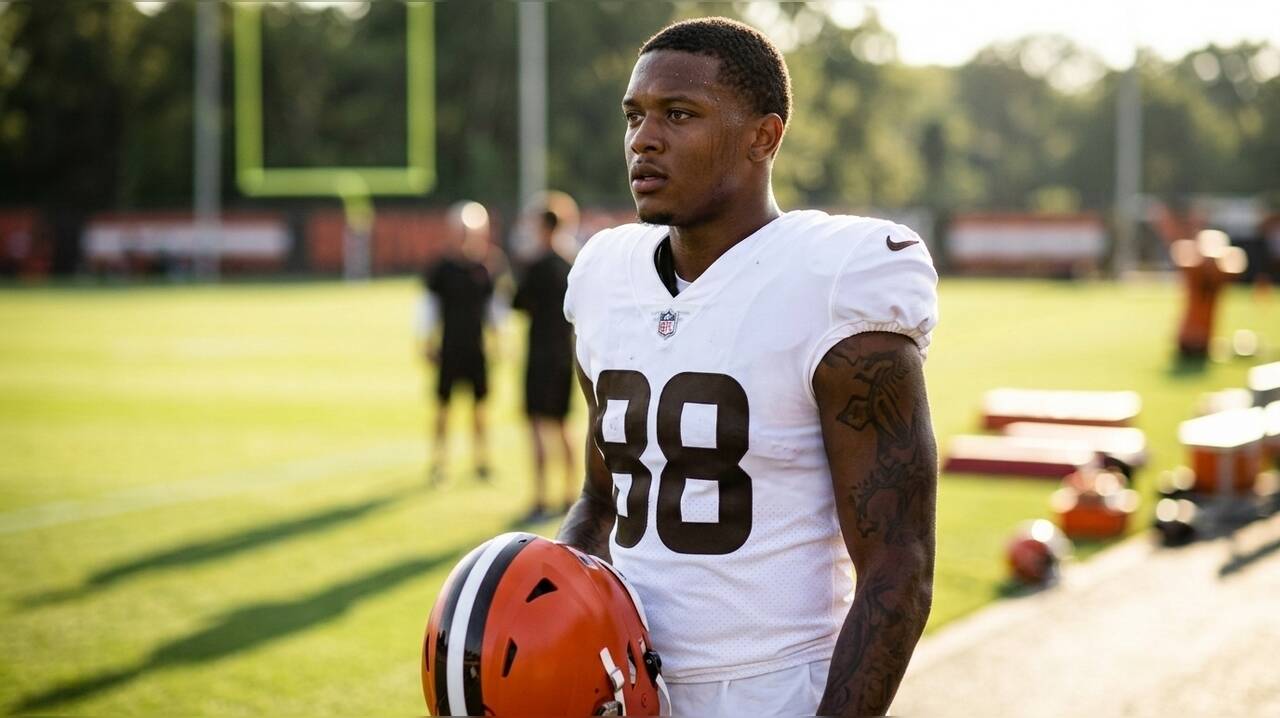
Welcome to India Edition SEVEN DAYS IN Cleveland epitomized the volatile landscape of eligibility in college sports -- and how the uncertainty is now seeping into the NFL. On Aug. 19, 33 athletes -- including then-Browns and former Ole Miss tight end Dae'Quan Wright -- were granted a temporary restraining order by a Louisiana state court to return to college for one more season. The following day, Wright was one of more than a dozen former FBS players, including athletes who had signed contracts with NFL teams, who entered their names into the NCAA transfer portal. On Saturday, Wright donned a Browns uniform and warmed up with the team ahead of Cleveland's second preseason game. He didn't play in the game, and by Tuesday, Cleveland waived Wright with a noninjury settlement, and Wright reached an agreement to play for his former college coach, Lane Kiffin, who is now at LSU. "Man, isn't this s--- crazy? I don't even know what to say," Browns coach Todd Monken said after Saturday's preseason game. "I cannot believe this is being green-lit on any level," a scouting executive for an NFL club told on Sunday. That disbelief proved a good instinct. On Tuesday night, the SEC issued a ruling intended to bar Wright from returning to play college football, making all of this moot -- that is, until the next lawsuit is filed. And on Wednesday, the NFL sent a memo reminding clubs that a player who signed an NFL contract and then returned to college would not be allowed to sign with an NFL team again this season, referencing an eligibility rule in the player personnel handbook. The news of Wright's return to the NCAA, along with three other players who had been on NFL training camp rosters this summer -- former New Orleans Saints defensive lineman Zxavian Harris and former Seattle Seahawks running backs TJ Harden and Anthony Hankerson -- has been the talk of the league over the past week. NFL coaches, executives and agents are sifting through questions and implications of the new reality, which seems to change by the hour. The NFLPA declined to comment to on Tuesday, and the NFL did not respond to a request for comment. Los Angeles Rams coach Sean McVay perhaps summed it up best when asked about NFL players returning to college: "I feel like I took a freakin' gummy." IN RECENT WEEKS, there has been a litany of legal action -- in federal and state courts -- by outgoing seniors seeking a fifth year of eligibility and the right to return to play college football in 2026 after the NCAA in June passed new eligibility rules allowing athletes to play five seasons within a five-year window. A Colorado federal judge issued a late July preliminary injunction in a class action case brought by former Buffaloes basketball player Brock Wisne, opening the door for all athletes who started college in the fall of 2022 to return for a fifth season. However, last week the 10th Circuit Court of Appeals granted the NCAA a stay in an order reversing the lower court's decision. Since then, state lawsuits have sprouted across the country from athletes seeking to play a fifth collegiate season. The suit that Wright joined in a Louisiana court is one of the latest that will allow a group of outgoing seniors who were not considered exceptions for the NCAA's eligibility rule change to return to college. Athletes who have filed separate lawsuits in state court and have received restraining orders are not impacted by the Wisne decision. If this sounds confusing, it's because it is. A compliance director for a Power 4 college football program, who wasn't authorized by his school to speak on the record, told on Tuesday that his school has two players who started college in the fall of 2022 occupying roster spots and practicing with the team, even though they are currently not eligible to play. When the NCAA changed its eligibility rules, the compliance director said his school's coaching staff started reviewing its 2025 roster to determine which players might be interested in returning. When the two players returned to the team after going undrafted and unsigned in the NFL, they had what seemed, at the time, a clear path to eligibility under the Wisne decision. The players still needed to apply to the NCAA for reinstatement because they had professionalized themselves by signing with agents and being part of the 2026 draft class. But on Friday, the NCAA won a stay on the Wisne decision, meaning the two players needed to pursue independent litigation if they wanted to play this season. The compliance director said the communication they received from the NCAA states that the organization plans to continue fighting each eligibility case filed against it. "We're two weeks out from the start of the season and a lot of this is not finalized, not resolved, and continuing to be fought," the director said Tuesday morning. "So yes, it could absolutely happen where someone is starting out the season playing and then that gets revoked in some way." Just a few hours after spoke to the compliance director, the Big Ten passed a rule barring any player who has declared for the NFL draft and has not withdrawn, appeared on an NFL roster, or signed a contract with a pro league from being on a member school's roster. The SEC later passed a similar rule prohibiting a player who signed a contract with an NFL team (or another professional football league) from appearing on a conference roster. And 's Pete Thamel reported Wednesday that the Big 12 athletic directors agreed to ban professionals returning to their conference schools. There is also momentum in the ACC to join the Big Ten and SEC in banning players who have joined NFL rosters from returning to college rosters, per Thamel. In a span of five days, these two fifth-year college football players went from having a clear path to eligibility through NCAA reinstatement to needing to file their own lawsuit to get a restraining order to being banned from returning by their conference. "Even though these players are being given this relief at the state level and on this initial [Wisne] decision, the NCAA is still fighting this tooth and nail," the compliance director said. "It's very ticky-tacky because it comes down to the particular states and how they're reviewing things. So it's not one big thing to be decided. It's many, many fires that need to be put out for them." A veteran NFC scout said this is the most "bizarre" aspect of college football right now. "It feels like it only takes one judge to change a law." • Giants, Jets on living and playing in NJ • C.J. Stroud's improved scrambling ability • Four under-the-radar 49ers • 4 issues Saints face ahead of final week of camp • What to expect from Jaguars' RBs in 2026 A Browns team source told that Wright, who originally signed with the Philadelphia Eagles as an undrafted free agent and joined Cleveland via waivers on Aug. 11, didn't factor into the team's long-term plans. However, this was an unprecedented situation, so the club consulted the NFL office for guidance on how they should roster-designate Wright. A source familiar with the league office's business said the NFL lawyers were looking into the consequences of the different designations to make sure they didn't put themselves at risk of a lawsuit, as the NCAA has. While the Browns and the league office examined the unfamiliar scenario last Wednesday, the day the plaintiffs in the Louisiana lawsuit received a restraining order, a rookie tight end had already arrived in town to replace Wright. He waited five days to sign. Though Wright was a long shot to make the Browns' 53-man roster, many around the league were curious about the domino effect of his departure and the precedent it could set. The conference bans have clouded the picture even further, and NFL sources have many unanswered questions, some of which may no longer even apply if the conference bans are successful. Does a college recruiting players on NFL rosters qualify as tampering? If undrafted players leave to go back to college, do clubs stop guaranteeing their salaries? Is there a future where players enter the draft early and return to college if they don't get drafted or aren't selected as high as they wanted? How does the NFL and NFLPA's collective bargaining agreement address these players? Does offset language apply in the players' contracts if they sign with a college team? Multiple NFL sources expressed the desire for more clarity from the NFL and the NCAA. On Sunday, an NFL general manager said that Wright's return to LSU has set a "tough precedent." "It's something that really needs to be addressed because it does open a door that is difficult for NFL teams and colleges alike," the general manager said. "It either has to happen on the college side where they don't sign these guys or the NFL makes it punitive for these players on reentry, which I don't know the legality of. It really ends up being a question of what is legal on both sides." "It should be as simple as you sign an NFL contract, you're ineligible for college," said one personnel executive. "If a guy went undrafted and unsigned, I'd have no issue with him going back to school." It's never too early to start your championship run. Create a league with friends and family, or join a public league today. Sign Up Now! The veteran NFC scout said it is like the COVID-19 pandemic year all over again, and the month of August in the league has been more about managing rosters than actual evaluation. "It's chaos; we're all out here trying to figure out who we need to evaluate at practice now," the scout said. "Who is coming out? Who is staying because now they have an extra year?" The veteran scout said the list of draft-eligible players at each school is long, and each school presents information to scouts differently. Some discuss all fourth-year players, even those this new rule didn't affect them, the scout said, while others present no fourth-year players, telling scouts that they are all coming back next year. "It's a complete guessing game at this point," the scout said. "It's exhausting, and it seems to be the new norm of college football." This year should be the height of the chaos, the compliance director said, because next year, "there shouldn't be any question of whether you have additional eligibility or not," and college athletes should be able to make more informed decisions. An AFC scout said he anticipates players will use their fifth year if they are projected to be a late-round pick or an undrafted free agent, which could lead scouts to be more transparent with schools about player projections and feedback. Another scouting executive said that because NIL has changed the finances of many prospects, his team has spent more time and effort this past year than ever before trying to determine whether a prospect actually wants to play in the NFL. None of the NFL players who are returning to college were expected to make a 53-man roster, so league clubs aren't losing a ton of sleep yet over this emerging trend. The rookies who were drafted and have a place on the team aren't a flight risk. But two NFL personnel executives said this could affect player development because they believe the opportunity to be on a practice squad is better for players acclimating to the NFL than returning to college football. "If it's a money grab, then fine," one of the executives said. "There's a subset of players that won't make the 53 but have a future if they stick in the system. They're the ones who could get hurt by this. Ideally being developed on a practice squad in a system that will pay dividends next year. Playing in college at age 22 or 23 delays development and the time it takes to become a UFA [unrestricted free agent]." The compliance director was glad to see the conferences define what they consider professionalism, but he considers those rules temporary measures until the NCAA steps in, and he doubts the bans will be enforceable. "It sounds to me like just another party to add to one of these lawsuits," the director said. "The NCAA will have to figure out where they're going to draw a line on something like this. How far towards becoming a professional athlete can you go before it starts to feel like you don't really belong in college football anymore?" One NFL personnel executive said he knows that colleges have been scouting and reaching out to players on the back end of NFL rosters for the past month or so. "I don't know how many have made direct contact with players or made formal offers, but they have been 'tampering,'" the executive said. Kiffin said LSU will recruit these players because "most people probably are." "This is a cluster of all clusters," a veteran NFL agent said. "And the NCAA is to blame. By protecting their own pocketbooks, which is all this has ever been, they have created a mess with so many unintended consequences over and over." Another NFL executive told on Wednesday night: "It's like the wild wild West. The wind is blowing every direction." IN TAMPA, FLORIDA, another rookie will soon have a choice to make. Former LSU linebacker Jack Pyburn is among a group of players who started college in the fall of 2022 who joined the lawsuit in Louisiana and were granted another year of eligibility. A few weeks ago at the start of Buccaneers training camp, Pyburn said his agent told him about the possibility of a senior season do-over, a backup plan if he doesn't make the Bucs or another NFL team's roster. "I didn't know about it until it was kind of on my doorstep," Pyburn said last week. "... The world of college football is wild, and I don't control it. I'm just a football player. I'm kind of caught in the middle of a whirlwind." When Pyburn didn't hear his name called in the 2026 NFL draft, he was filled with regret. I didn't work hard enough, he thought. "When I reflect back on it, whether I was at Florida or LSU, I just did not dedicate my life to it. And simply this is everything that I've ever wanted since I was a kid," Pyburn said. After going undrafted, Pyburn signed as a free agent with the Buccaneers and had two sacks in the first preseason game, catching the eye of coach Todd Bowles, who said, "He made us watch it. He made it known." For now, Pyburn said he's focused on making the Buccaneers roster, and that his agent is managing the rest and working to protect his best interests. He said his agent told the Tampa Bay coaching staff that returning to college was a possibility for him as a backup. "It's a crazy landscape," Pyburn said. "There's guys all over the place that have been dropping lawsuits for the past year and for eligibility reasons." Unlike Wright, who was waived by the Browns so that he could attend LSU, Pyburn has remained in training camp. He participated in joint practices this week against the Jaguars, and he will play in the third preseason game Friday night in Jacksonville -- his hometown. His backup option might not be as simple as it was when he spoke to reporters about this last week, well before the SEC passed its ban on NFL players returning. He's not clear on when he'll decide, but the cut-down deadline is Sunday at 6 p.m. ET. Teams have until Monday at 1 p.m. ET to submit waiver claims. They can then begin assembling their practice squads once waiver claims and cuts are finalized. According to attorney Ryan Downton, who is representing athletes in the Louisiana lawsuit, if the players' NFL teams release them by Tuesday, they will be allowed to join a college roster under the restraining order. When presented last week with the scenario of playing college football or being on an NFL practice squad (in which rookies make $13,500 per week), Pyburn didn't have an answer. "That's a decision I'm going to have to make with my family and talk with my agents and see what's the best business decision and what's the best option for me in my future career," Pyburn said. reporters Dan Murphy, Pete Thamel, Max Olson, Jenna Laine, Katherine Terrell, Sarah Barshop and Mike Kaye contributed to this report.
NFL
How is NFL dealing with players heading back to college? 'Cluster of all clusters' -
- Authored By: Sports Now
- Updated Aug 27, 2026, 18:38 IST