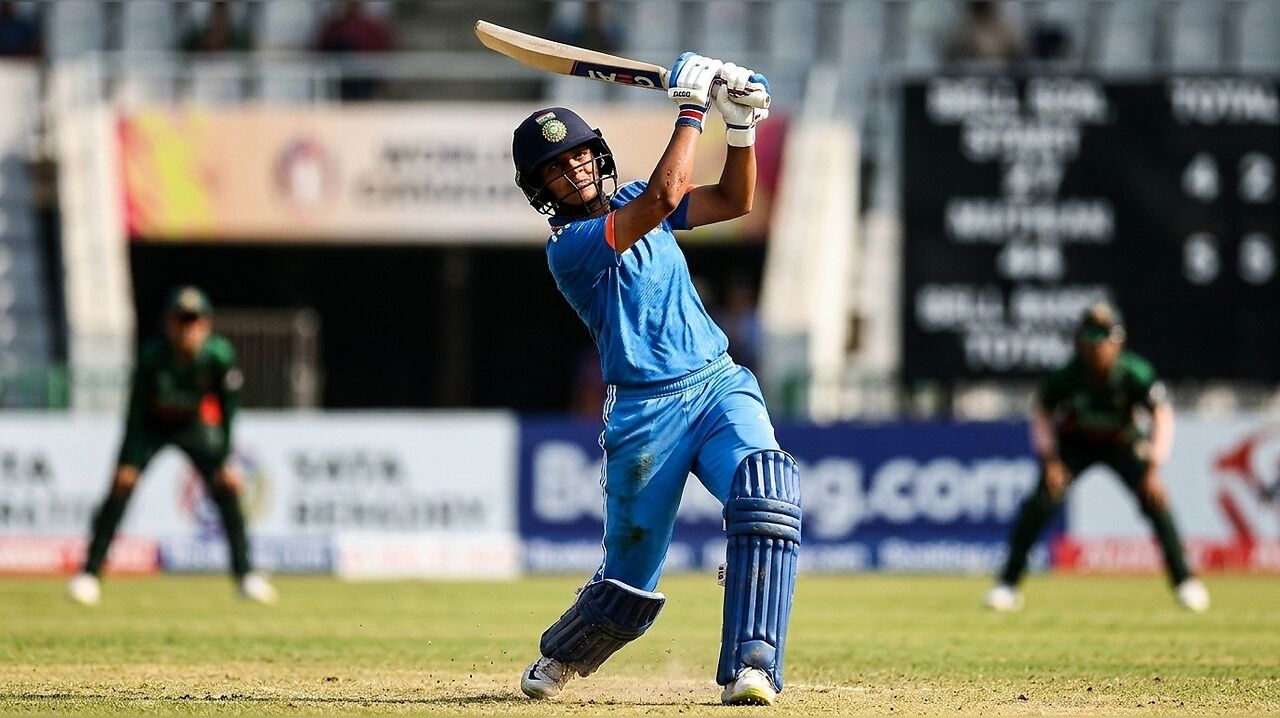
The innings, which marked her eighth century in the format, proved vital after India opted to bat first and faced early pressure. Alongside a brilliant unbeaten 106 from
A Masterclass in Recovery and Partnership
India’s innings began on shaky ground after electing to bat. The team lost opener Smriti Mandhana in the very first over, followed shortly by Shafali Verma, who was dismissed at mid-wicket. With the scoreline under pressure, Harmanpreet found a reliable partner in Pratika Rawal. The pair constructed a crucial 124-run stand that stabilized the innings, with Rawal contributing a fluent 61 off 67 balls before falling in the 23rd over.
Following Rawal’s departure and the subsequent loss of Tejal Hasabnis, Harmanpreet took full control of the crease. Her ability to pace the innings ensured India remained on track for a high total. She eventually found an ideal partner in Deepti Sharma, with the duo putting together a dominant 153-run partnership that effectively took the game away from the visitors. Harmanpreet’s innings finally concluded at 126 when she was caught at long-off by substitute fielder Kudzai Chigora off the bowling of Michelle Mavunga.
Deepti Sharma’s Century and Historic Context
While Harmanpreet’s milestone took center stage, Deepti Sharma’s contribution was equally significant. Scoring an unbeaten 106 off just 86 balls, she struck 15 boundaries throughout her stay at the crease. Her second ODI century was confirmed in the final over with a well-placed four toward square leg, ensuring India finished their 50 overs with momentum despite the late loss of Richa Ghosh.
This fixture marks the first time India and Zimbabwe have met in a bilateral women's ODI series. With her eighth century, Harmanpreet now sits outright second on India's all-time list of women's ODI centurions, trailing only Smriti Mandhana, who leads with 14. Mithali Raj now moves to third on the list with seven centuries, followed by Punam Raut, Jemimah Rodrigues, and Pratika Rawal, who each have three.